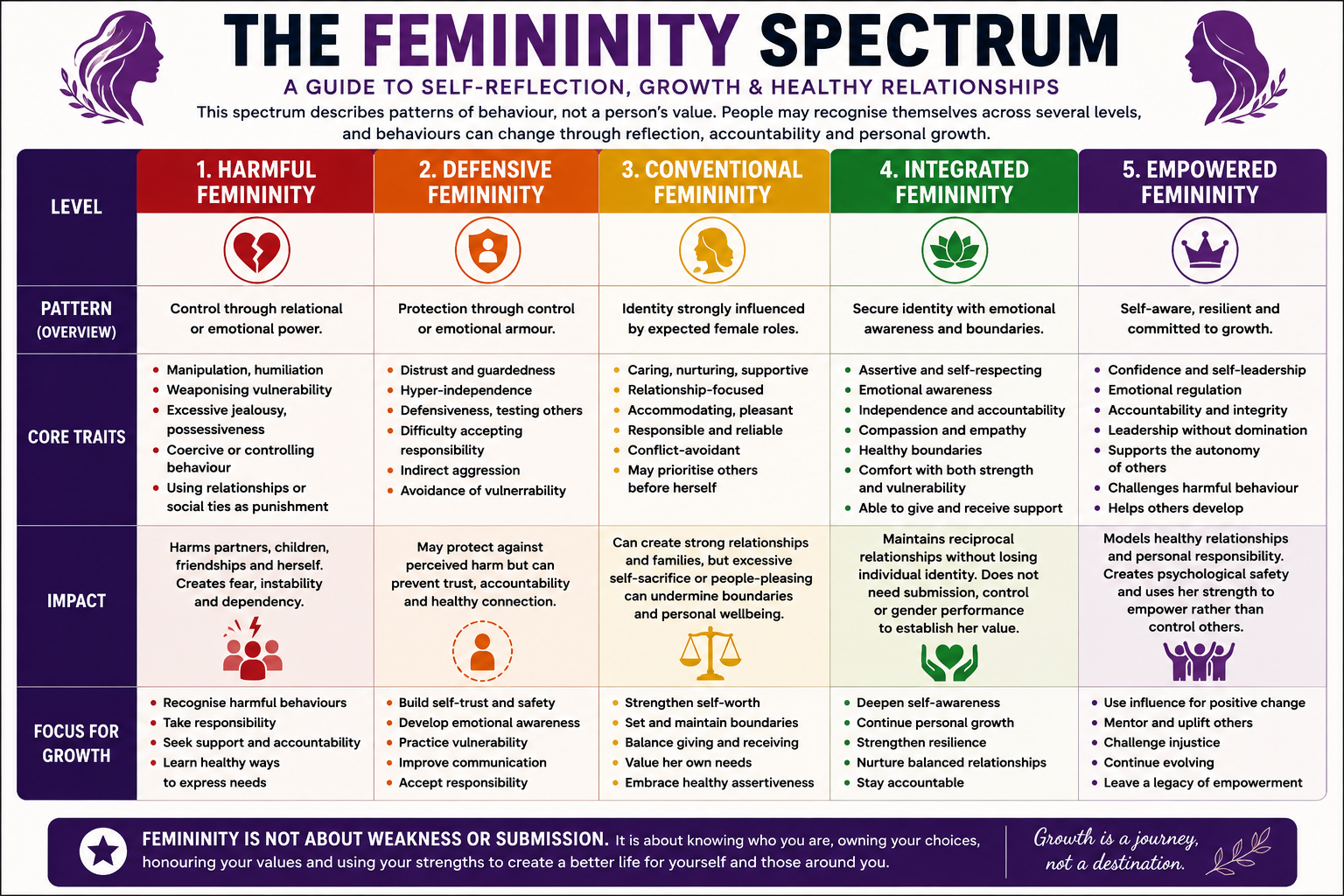
The DVFS Femininity Spectrum Chart
The DVFS Femininity Spectrum is a behavioural self-reflection tool designed to explore how different patterns of femininity can influence a person's relationship with herself and with the people around her.
The spectrum is not intended to define what makes someone a “good woman”, nor does it suggest that women must behave in traditionally feminine ways. Instead, it looks at behaviours that can develop around identity, relationships, emotional expression, boundaries, independence, accountability and the use of personal or relational power.
The spectrum moves through five broad patterns: Harmful Femininity, Defensive Femininity, Conventional Femininity, Integrated Femininity and Empowered Femininity.
At the harmful end of the spectrum, behaviours may include manipulation, humiliation, excessive jealousy, possessiveness, coercive behaviour or using relationships and social connections as a means of control or punishment. These behaviours can cause significant harm regardless of the gender of the person displaying them.
Defensive femininity describes behaviours that may develop around self-protection. A person may become highly guarded, distrustful or defensive, struggle with vulnerability or accountability, or rely heavily on independence and emotional distance. Some of these behaviours can be protective in certain circumstances, but when they become rigid they can also make healthy communication, trust and relationships difficult.
Conventional femininity includes many qualities traditionally associated with women, such as nurturing, caring, supporting others and placing importance on relationships and family. These qualities are not inherently unhealthy. Difficulties can arise when caring for others becomes excessive self-sacrifice, people-pleasing, avoidance of conflict or consistently placing another person's needs above one's own wellbeing and boundaries.
Integrated femininity combines compassion and connection with independence, assertiveness, emotional awareness and healthy boundaries. A woman can care deeply about other people without losing her individual identity. She can accept support without surrendering her independence, express vulnerability without viewing it as weakness, and take responsibility for her behaviour without allowing others to define her worth.
Empowered femininity builds upon this foundation. It reflects continued self-awareness, emotional regulation, resilience, accountability and the ability to use personal strength or influence without controlling others. It can also involve supporting the autonomy and development of others, challenging harmful behaviour and modelling healthier relationships within families, workplaces and communities.
Importantly, the Femininity Spectrum is not a ladder that permanently places women into one of five categories.
People may recognise behaviours from several parts of the spectrum at the same time. They may also behave differently depending on their relationships, circumstances and stage of life. Someone might recognise that they previously relied heavily on self-sacrifice or defensiveness but have since developed stronger boundaries and greater confidence.
Movement can also occur in either direction. Stress, trauma, unhealthy relationships, isolation or major life changes can affect how someone responds to other people. Likewise, reflection, accountability, support and personal development can help someone change behaviours that are no longer healthy.
For this reason, the most useful question is not:
“Which type of woman am I?”
It is:
“Which of these behaviours do I recognise in myself, and where would I like to grow?”
The purpose of the DVFS Femininity Spectrum is ultimately not to prescribe femininity. It is to provide women with an accessible way to examine behaviour, recognise strengths and unhealthy patterns, develop stronger boundaries and relationships, and understand personal growth as something that continues throughout life.
There is no requirement to become a particular kind of woman.
The goal is simply to become healthier than the person you were yesterday.
0 Comments Add a Comment?